

The Essential STEM Skills Your Child Needs Before Age 10
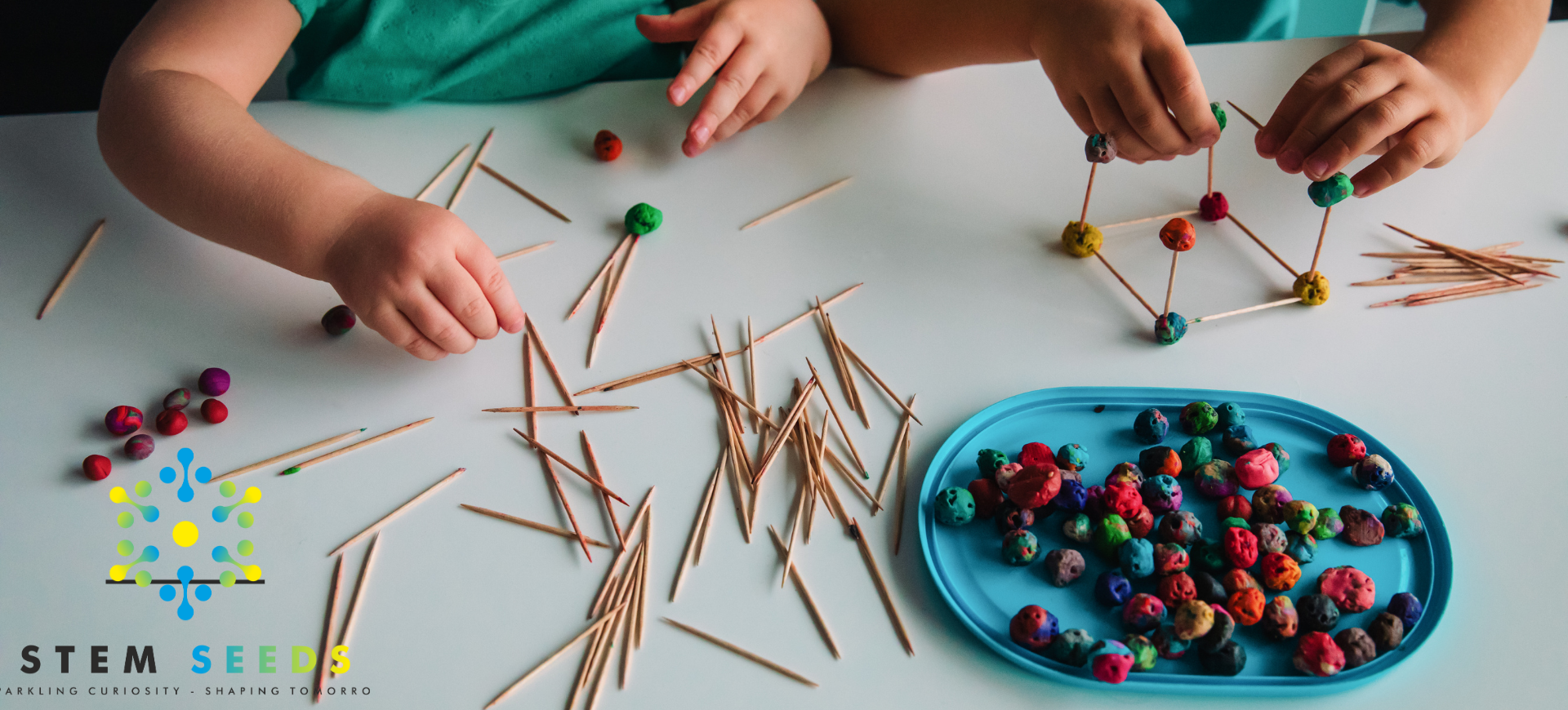
In today’s rapidly evolving world, STEM skills (Science, Technology, Engineering, and Math) are as essential as learning to read. Studies show that children who grasp fundamental STEM concepts by age 10 are more likely to excel academically and develop problem-solving abilities crucial for future careers.
Did you know? 90% of brain development happens before age 5, making early childhood the ideal time to introduce STEM learning through play-based activities. The best part? You don’t need expensive gadgets or a science background to help your child build these essential skills.
This blog explores the must-have STEM skills every child should develop before age 10 and provides simple, engaging ways to cultivate these skills at home and in the classroom.
Critical Thinking Skills: Building Your Child’s Mental Toolkit
When little Priya couldn’t reach her toy on the shelf, she didn’t just cry for help. Instead, she dragged a stool, stacked her books on top, and climbed up to get it. That’s critical thinking in action!
Critical thinking is like a mental muscle that grows stronger with exercise. By age 3-4, children start asking “why” questions and solving simple problems. By 7-8, they can consider multiple solutions and predict outcomes. And by age 10, they should be able to evaluate information and make reasoned decisions.
Spotting Critical Thinking in Everyday Life
Your child is using critical thinking skills when they:
- Ask thoughtful questions beyond simple “what” questions
- Test different approaches when facing challenges
- Make predictions about what might happen next
- Explain their reasoning for decisions
- Notice patterns and connections between ideas
Nurturing These Skills at Home
Critical thinking flourishes in homes where questions are welcomed, not rushed. When your child asks why the sky is blue, instead of giving an immediate answer, try asking: “What do you think?” This simple response invites them to develop their own theories.
During daily routines, involve your child in decision-making: “We need to pack your school bag. What do you think you’ll need tomorrow?” These small opportunities help build independent thinking.
Basic Numeracy and Mathematical Thinking
Remember watching your little one count their fingers with pride? That simple moment was the beginning of a mathematical journey! By age 10, that same child should be comfortable with numbers in ways that will serve them throughout life.
Mathematics isn’t just about calculations—it’s about understanding patterns, relationships, and problem-solving. When children develop strong number sense early, they approach math with confidence rather than fear.
Essential Math Milestones Before Age 10
Your child should gradually develop these key concepts:
- Number recognition and counting (ages 3-5): Not just reciting numbers, but understanding that “5” represents five objects
- Basic operations (ages 5-7): Addition, subtraction, and the beginnings of multiplication and division
- Place value (ages 6-8): Understanding that in “52,” the “5” means fifty
- Fractions and decimals (ages 7-10): Seeing that numbers exist between whole numbers
Everyday Math: Turning Daily Activities into Learning Opportunities
Math is everywhere—help your child see it through shopping adventures (estimating costs), time awareness (“We need to leave in 15 minutes. What time will that be?”), pattern hunting in designs, measurement projects, and basic money management.
The magic happens when children stop seeing math as something that only happens in workbooks and start recognizing it as a tool they use every day.
Scientific Method and Inquiry: Raising Little Scientists
Young children are natural scientists—curious, observant, and eager to experiment. The scientific method isn’t just for labs and classrooms. It’s a powerful way of thinking that helps children make sense of their world.
At its heart, science follows a pattern that even young children can understand:
- Wonder and observe: Notice something interesting
- Ask questions: Get curious about why or how
- Make a guess (hypothesis): “I think this happens because…”
- Test it out: Try something to see what happens
- See what happened: Look at results
- Share what you learned: Talk about discoveries
Age-Appropriate Science Exploration
Ages 3-5: Focus on observation using all senses. “How does this leaf feel? What happens when we mix these colors?”
Ages 6-7: Children can make simple predictions and test them. “Which ball do you think will roll faster? Let’s test it!”
Ages 8-10: Introduce more structured experiments with one variable. “Does adding salt to water change how quickly ice melts?”
The most powerful phrase in science isn’t “Eureka!” but “I wonder why…” Nurture this questioning spirit by responding to questions with enthusiasm, answering questions with questions, and embracing uncertainty with “I don’t know, but let’s find out!”
Spatial Reasoning and Engineering Foundations
When seven-year-old Arjun arranged blocks to create a bridge strong enough to hold his toy car, he wasn’t just playing—he was developing crucial spatial reasoning skills that could one day help him design real bridges or understand complex mathematics.
Spatial reasoning—the ability to think about objects in three dimensions and visualize how they might change or fit together—is perhaps the most overlooked yet critical foundation for STEM success. Research shows that children with strong spatial skills are more likely to pursue and excel in STEM fields later in life.
The Power of Building and Construction Play
Those seemingly simple moments of stacking blocks, assembling puzzles, or building forts are complex brain-building activities. When children construct, they:
- Develop an intuitive understanding of physics and structural integrity
- Learn to visualize and plan before building
- Practice problem-solving when structures collapse
- Build persistence by trying different approaches
- Experience early engineering principles firsthand
You don’t need expensive toys to develop strong spatial thinkers. Simple activities like block play, origami, map drawing, tangram puzzles, and building with natural materials all strengthen spatial skills that transfer to later STEM learning.
Basic Coding and Algorithmic Thinking
Coding isn’t just about typing on keyboards—it’s about developing a powerful way of thinking. Algorithmic thinking—breaking down problems into logical sequences—is a skill that benefits children in every area of life, from organizing homework to solving complex challenges.
Before children ever touch a computer, they can develop the thinking patterns that make coding intuitive through playful, physical activities:
- Human-Robot Game: One child acts as a “programmer” giving specific movement instructions, while another acts as the “robot” following them exactly.
- Obstacle Course Programming: Create a simple course, then have children write “code” using arrow cards or symbols before navigating it.
- Recipe Algorithms: Cooking together highlights the importance of following steps in order.
When children are ready for digital experiences, start with age-appropriate options like coding apps with visual blocks (ScratchJr), simple robot toys, or block-based coding platforms like Scratch. Another great tool is OctoStudio, an intuitive coding app that allows children to create interactive stories, animations, and games, making coding an engaging and accessible experience for beginners.
Communication and Collaboration: The “Secret Sauce” of Success
When we picture great scientists or engineers, we often imagine lone geniuses working in isolation. The reality? Today’s greatest STEM breakthroughs come from teams of people working together, sharing ideas, and building on each other’s work.
In the real world of STEM careers:
- Engineers must explain complex designs to clients and teammates
- Scientists need to clearly document their experiments for others to replicate
- Mathematicians collaborate to solve problems no individual could tackle alone
Build these skills through team challenges like bridge-building competitions, back-to-back building exercises where children must describe structures without showing them, and group projects that require different strengths.
Help children articulate their thinking by asking process questions (“How did you figure that out?”), introducing thinking words (“First I predicted…” “My evidence shows…”), and creating documentation habits like drawing or recording observations.
Persistence and Growth Mindset: The Secret Ingredient
What separates successful STEM learners from those who give up? It’s rarely intelligence or talent alone. The critical difference is often a quality researchers call “growth mindset”—the belief that abilities can be developed through dedication and hard work.
In STEM fields, failure isn’t just normal—it’s necessary! Children need to understand that STEM success isn’t about getting things right the first time—it’s about learning from each attempt and persisting until solutions emerge.
The words we use around children powerfully shape how they view challenges. Small shifts in language can transform a child’s persistence:
Instead of: “You’re so smart!”
Try: “You worked so hard to figure that out!”
Instead of: “Are you sure you’re good at science?”
Try: “This is challenging, but you’ll get better with practice.”
Create a safe space for struggle by sharing your learning challenges, celebrating effort and improvement (not just success), and normalizing the discomfort that comes with learning.
Digital Literacy Foundations
Today’s children are digital natives, born into a world where technology is as familiar as pencils and paper were to previous generations. Yet true digital literacy goes far beyond simply knowing how to swipe a screen.
Digital literacy means using technology thoughtfully, creatively, and safely—skills increasingly essential in today’s world. Children who develop healthy tech habits early approach digital tools not as passive consumers, but as empowered creators and critical thinkers.
Create a healthy digital diet by setting clear boundaries, focusing on quality over quantity, and modeling healthy habits yourself. The goal isn’t to eliminate technology but to use it intentionally and alongside other important developmental activities.
The most powerful way to build digital literacy is by using technology to create rather than simply consume through digital storytelling, coding through play, virtual exploration, and family tech projects.
STEM Seeds is nurturing digital literacy in preschoolers by transforming technology from a passive tool into an interactive learning experience. Through digital storytelling, coding through play, and hands-on tech exploration, young learners develop creativity, problem-solving, and critical thinking skills. By integrating age-appropriate tech activities, STEM Seeds ensures that children build healthy digital habits while engaging in meaningful, play-based learning.
Supporting Different Learning Styles in STEM
Children don’t just differ in what they’re interested in—they differ in how they learn best. When we recognize and support these diverse learning styles, we unlock each child’s potential for STEM success.
Watch your child in moments of natural learning to discover their preferences:
- Visual learners process information best through seeing and observing
- Auditory learners thrive when they can discuss, explain, and listen
- Kinesthetic learners learn through movement, touch, and physical engagement
The most powerful STEM learning experiences engage multiple senses and learning approaches simultaneously. When a child can see, hear, and physically interact with a concept, the learning becomes more robust and accessible to all.
Conclusion: Nurturing Tomorrow’s Innovators
The essential STEM skills children need by age 10 aren’t just academic checkboxes—they’re powerful thinking tools that shape how children understand and interact with their world. From critical thinking and mathematical reasoning to spatial awareness and digital literacy, these foundational skills work together to create confident, capable young minds.
Remember that developing STEM skills doesn’t require expensive kits or advanced degrees. STEM learning happens in everyday moments—in the kitchen, in the garden, on walks, during play, and in curious conversations.
Beyond any specific skill, the most valuable STEM foundation we can give children is the belief that they are capable of understanding their world—and the enthusiasm to keep exploring it. When a child sees themselves as someone who can figure things out, solve problems, and learn new things, they’ve gained something more valuable than any single concept or fact.